
Number of human remains found at Queensgate Roundabout works revealed - and it could increase again
The number of human remains found at Queensgate Roundabout works could increase again as excavation continues, according to the latest information from the site.
The number of skeletons and human remains found during works taking place at Queensgate Roundabout has been revealed by the city council - with the warning that the figure could increase further.
Works have been ongoing at the site for several months now, as part of the ambitious Station Quarter project, which will transform that area of the city.
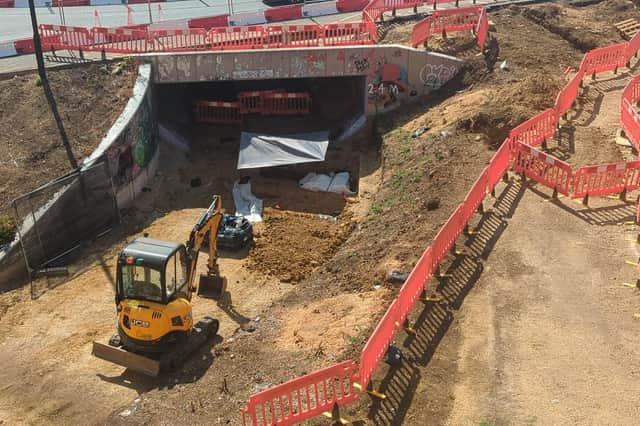

The project was set to last around a year - but early on, significant delays were reported.
The Peterborough Telegraph broke the news that a number of skeletons had been found by workers - perhaps not a surprise, given the roundabout was built on a historic cemetery.
When the news broke in July, a total of seven human remains had been found.
As works have continued, more and more have been found by workers - and now nearly 100 have been discovered.
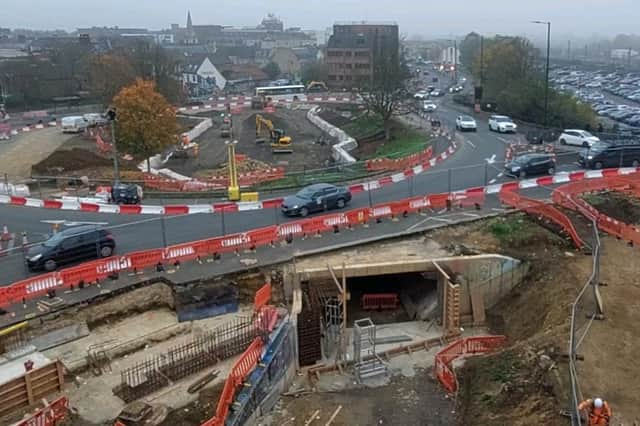
The finds have seen the major roadworks scheme taking place in the city delayed by nearly three months – and added another £1.5 million to the bill.
It had been thought that all the remains were moved when the roundabout was built in the 1970s - but this has proved not to be the case.
A spokesperson for Peterborough City Council said: “A total of 93 skeletons have been discovered so far. Oxford Archaeology will be on site until next week, so that figure could still increase."
It was thought that remains from this cemetery were cleared when subways were built at the roundabout during the 1970s.
Along with the remains, some crypt walls have also been found.
Many of those walls were visible to pedestrians and motorists as they navigated the area - but they have now been removed from sight.
When the initial discoveries were made, a spokesperson for Peterborough City Council said: “ We believe that these remains date from a cemetery which existed on this site during the Mediaeval period and later developed in the Victorian period.
“The cemetery was then believed to be closed to new burials in 1858. It was thought that remains from this cemetery were cleared when subways were built at the roundabout during the 1970s.”
Once all the archaeology work has been concluded, the remains will be given a Church of England burial elsewhere in the city - believed to be at Eastfield Cemetery, where remains found during the work in the 1970s were buried.
Why remains were a surprise to council
The Peterborough Telegraph has asked the council exactly what was expected to be discovered when the project began, given it was well known the site was a former graveyard – and if, in hindsight, more could have been done in advance to prepare for remains being found.
Councillor Angus Ellis, cabinet member for transport at Peterborough City Council, said: "As the site had previously been a cemetery, there was always a risk that skeletons could be found. However, our records showed the cemetery had been cleared and the digging we had to do on this project was anticipated to be fairly minimal - we only had to dig a few feet down in one specific location at the northern side of the site, to create the drainage system.
Our records showed the cemetery had been cleared and the digging we had to do on this project was anticipated to be fairly minimal
"It would have been difficult to detect these through non-intrusive techniques, such as geophysical surveys, due to the relatively small size of the skeletons and the 'background noise' caused by the construction of the subways and the materials used.
"Once the first skeleton was found, a burial licence was applied for an obtained from the Ministry of Justice and archaeologists attended the site. We have been working with the archaeologists to ensure the skeletons have been exhumed correctly.
"Our historical records show the cemetery was very full and we have been told by archaeologists that bodies had been buried on top of each other to ensure there was enough space for future burials. That means that the ones we have been discovering are likely the original burials when the cemetery first opened.”
The Parish Burial Ground
In use between 1805 and 1858, the Parish Burial Ground was located on a three-acre site at the bottom of Cowgate, covering the present-day Queensgate Roundabout.
The burial ground was opened in the early 19th century due to the lay-persons cemetery on the north side of the Cathedral becoming overcrowded.
According to the Peterborough Civic History Society, the first person buried at the site was Elizabeth Money in March 1805.
Like many cemeteries of the Georgian and Victorian eras, the Parish Burial Ground suffered at the hands of grave robbers.
In a time of advances in medicine and surgery, the demand for human bodies for dissection was high.
With medical schools constantly in need of bodies, grave robbers would steal freshly-buried corpses to sell on.
The worst years for body-snatching at the Parish Burial Ground were between 1827 and 1830. As a result, the walls around the burial ground were replaced with iron railings.
The Parish Burial Ground stopped accepting new burials in the late 1850s, but remained open for members of the public to tend to graves.
The site remained largely unchanged for the subsequent four decades, before a number of gravestones were removed in 1911 for a road redevelopment.
By the late 1970s, all visible signs of the burial ground had been removed to allow for the Queensgate Shopping Centre redevelopment.