
Queensgate Skeletons: Why discoveries were so shocking - despite knowledge of historic graveyard
The discovery of more than 60 skeletons at the Queensgate Roundabout has been a story that has dominated the Peterborough headlines over the summer and early autumn.
The finds – which at the last count included 61 human remains, as well as a number of tombs and burial chambers – have seen the major roadworks scheme taking place in the city delayed by nearly three months – and added another £1.5 million to the bill.
But the one question that countless people have asked since the first find was made at the very start of the works in June is this: Why did Peterborough City Council not know there were human remains at the roundabout, given that it is common knowledge there used to be a graveyard there?
Some on social media have even suggested – despite plaques being located on the roundabout at the junction with Cowgate – that the council didn’t even know it used to be a burial ground.
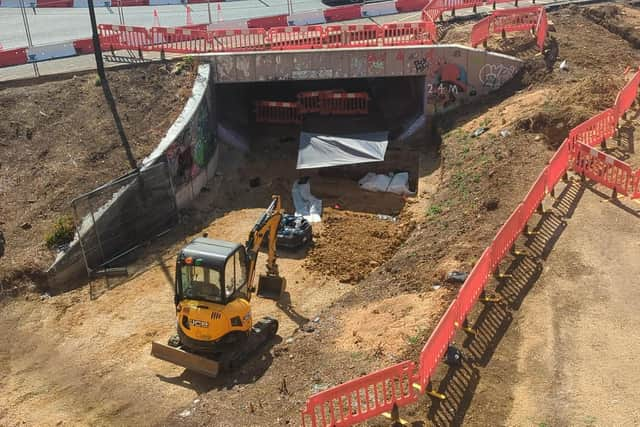

Now this is clearly untrue – but is it harsh to suggest that remains might have been discovered when the works began?
It had been thought the remains had been cleared in the 1970s when the roundabout was created – but that has not been the case.
The Peterborough Telegraph has asked the council exactly what was expected to be discovered when the project began – and if, in hindsight, more could have been done in advance to prepare for remains being found.
Councillor Angus Ellis, cabinet member for transport at Peterborough City Council, said: "As the site had previously been a cemetery, there was always a risk that skeletons could be found. However, our records showed the cemetery had been cleared and the digging we had to do on this project was anticipated to be fairly minimal - we only had to dig a few feet down in one specific location at the northern side of the site, to create the drainage system.
"It would have been difficult to detect these through non-intrusive techniques, such as geophysical surveys, due to the relatively small size of the skeletons and the 'background noise' caused by the construction of the subways and the materials used.
"Once the first skeleton was found, a burial licence was applied for an obtained from the Ministry of Justice and archaeologists attended the site. We have been working with the archaeologists to ensure the skeletons have been exhumed correctly.
"Our historical records show the cemetery was very full and we have been told by archaeologists that bodies had been buried on top of each other to ensure there was enough space for future burials. That means that the ones we have been discovering are likely the original burials when the cemetery first opened.”
The remains will be reburied, with a Church of England service, once they have all be safely exhumed.
MORE: EXPLAINED: What will happen to the skeletons that were found beneath the Queensgate Roundabout?
The Peterborough Telegraph understands that it has not been possible to identify any of the remains – but they include adult men and women, and boys and girls.
The cemetery was in use during Medieval times and later developed in the Victorian period.
Plans for a memorial at the roundabout are being worked on by the city council.