
Innovation is key says Peterborough business owner as new survey warns of stagnating local economy

An enterprising business owner in Peterborough has urged companies to innovate to succeed in the face of new warnings of a stagnating local economy.
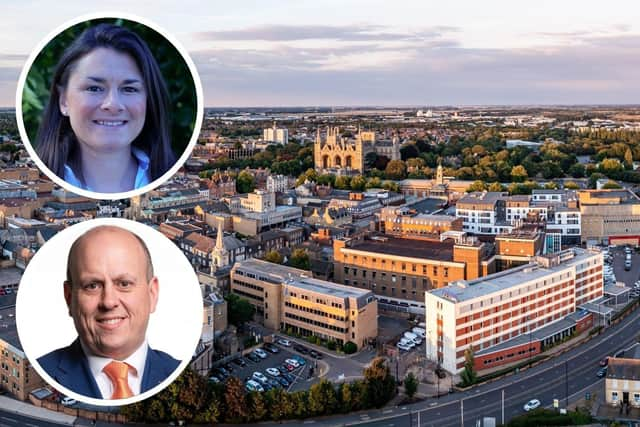
Mark Shortland, founder and chief executive of retail lighting supplier Shoplight, in Titan Drive, says that businesses that are agile and willing to innovate can still find ways to succeed despite a tough trading environment.
His comments come in the wake of the publication of Cambridgeshire Chamber of Commerce’s Quarterly Economic Survey for Peterborough and the county for the first three months of the year which reveals worsening cost pressures, declining export performance and continued economic stagnation across the region.
It warns that businesses across Cambridgeshire, Peterborough and Stamford are facing mounting pressures as rising costs and weakening demand limit growth.

The report shows that economic conditions have tightened further since the end of 2025, with key indicators pointing to a continued period of stagnation for many firms.
Key findings from Chamber’s economic survey:
- International trade is a concern, with 41 per cent of businesses reporting a decrease in overseas sales, up from 30 per cent in the previous quarter
- Domestic performance remains subdued, with just 25 per cent of firms reporting increased UK sales and only modest growth in orders
- Labour costs are most significant challenge, rising from 80 per cent in Q4 to 84 per cent in Q1 – higher than national figure where 73 per cent of firms cite labour costs as a concern
- Concerns about utilities are up from 48 per cent to 62 per cent, while fuel costs have risen from 23 per cent to 32 per cent
- Fewer firms expect turnover to improve and many remain uncertain about profitability in the months ahead
- Labour market pressures persist, with 56 per cent of businesses attempting to recruit and the majority continuing to face difficulties, particularly in skilled and professional roles
- Signs of reduced investment are emerging, with fewer businesses engaging in training and stable cashflow levels declining.
Charlotte Horobin, the chamber’s chief executive, said: “The message from businesses is clear.
"Costs are rising, demand is falling, and confidence is fragile.
"Government must act now to ease the burden on firms and unlock growth before these pressures become further entrenched.”
‘Focusing on innovation... we’ve been able to continue performing strongly despite the conditions’
Mr Shortland said: “The findings from the Chamber’s latest survey certainly resonate with what we’re seeing on the ground.
"While we broadly share the concerns highlighted in the survey, our experience also shows that businesses that are agile and willing to innovate can still find ways to succeed, even in a stagnating economy.
"By focusing on innovation, improving efficiency and adapting our offering to meet changing customer needs, we’ve been able to continue performing strongly despite the conditions.
Mr Shortland said: “There is no doubt that the broader economic environment remains very challenging, with persistent cost pressures, subdued demand, and ongoing uncertainty all weighing on business confidence.
"In our case, rising input costs and a policy environment that increasingly adds complexity and burden to employers are making it harder to plan, invest, and grow.
"Measures that were perhaps intended to stabilise the economy are, in practice, creating headwinds for companies trying to expand and create jobs.
"This is particularly noticeable in areas like taxation and regulatory requirements, which continue to increase the cost of doing business.
He added: “That said, while the macro picture is difficult, we’ve taken a very proactive approach internally.”
‘Rising costs... means that we’re looking into the medium term with some trepidation.’
But rising costs are proving a major headache for businesses in the hospitality industry where hard-pressed customers might opt to save their money and stay at home.
Nick Jones, off trade and export manager at Oakham Ales, in Maxwell Road, in Woodston, said: “We’ve possibly been less impacted than some other sectors in terms of day to day cost pressures although that’s not to say of course that they’ve been negligible.
"Where we have struggled is with regards to the very significant costs of getting our maintenance and replacement programme back on track after the huge financial shock associated with the pandemic lockdowns and the generally lower level of trade since 2020/2021.
“Obviously rapidly rising energy and fuel costs are a really major worry going forward, although in terms of electricity costs we are insulated to an extent by the solar panels we installed last year and which supply a useful proportion of our energy needs at below grid prices.
“However, the solar power generated on site won’t fulfil all of our electricity needs and we are also a big consumer of gas, so we’d have to say that the impact of what are likely to be very significant rises energy costs due the instability of the geopolitical landscape is a huge worry for us - brewing is after all a high energy use industry.
“Sales aren’t actually doing too badly, albeit well below pre-pandemic levels.
“We’re currently running at around or just under last year’s figures in real terms but the impact of rising costs on ourselves and the hospitality industry and its customers means that we’re looking into the medium term with some trepidation.”
“As for export, the significant difficulties caused by Brexit and then the hiatus of COVID mean that we haven’t exported our beers in any quantity since 2019.”