
200 not out! Oundle Town Cricket Club's journey from a 'racecourse near Stamford' to a stable housing international players
Some cricketers play for fun. Others take the field for pots, points or pounds.
But the early warriors who established Oundle Town Cricket Club 200 years ago in the summer of 1826 - when Lord Liverpool was prime minister and Beethoven ailing but still alive in Vienna - had their eyes on a very different and altogether more nourishing prize.
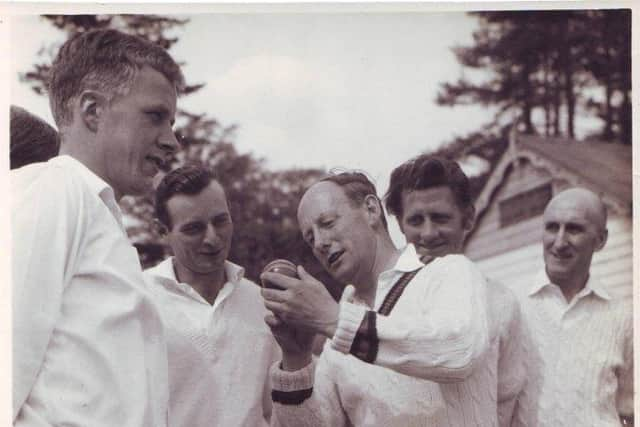

‘Yesterday a well-contested match was played for “a rump and dozen” (steak and eggs) in which the rising merits of every player was observed with much pleasure by the spectators,’ according to the Huntingdon, Northampton, Bedford and Cambridge Weekly Journal, reporting that ‘the gentlemen and tradesmen of this town and neighbourhood have lately established a cricket club.’
It continued: ‘After the sports of the day, the party partook of an elegant entertainment at the Dolphin Inn (where) the rosy wine was briskly circulated…’

The Dolphin still stands - now known as ‘Old Dryden’, part of the Oundle School estate - and it’s entirely appropriate that the club’s bicentenary cricket week in June will begin with a launch event in that very same building.
The Badgers, with former England batsman John Crawley newly installed as President, would dearly love to celebrate this extraordinary milestone by securing a first Northamptonshire League top division title.
But the ambitions of Oundle Town’s founding fathers were relatively modest.
Detailed scorecards from the formative years are few and far between; the earliest dates from July 24, 1837, a month into Queen Victoria’s long reign, when Oundle lost heavily to Bourn’s village team in a match played on neutral territory at ‘the racecourse near Stamford.’
The first major threat to the new club’s survival came from a surprising quarter.
In 1853, Oundle School made Mrs Curtis, then-owner of the current Milton Road ground, a better offer and effectively ‘gazumped’ the town’s cricketers who were obliged to lead a nomadic existence for the next three decades.
Rumour has it that some of the club’s older members still bear a bitter grudge…
International players including Dawid Malan, Tshepo Moreki, Denesh Ramdin and local boy Josh Hull have all worn Oundle Town colours in recent years, but any number of other remarkable individuals (albeit less talented with bat and ball) feature in OTCC’s annals.
The Honourable John Powys turned out regularly around 1890 and later, as Lord Lilford, served as President and generous benefactor of the Northamptonshire county club either side of the First World War.
When Oundle tackled Lilford Park in 1901 a master at the School, Bertie Grace, flayed the bowling to all parts in a memorable knock of 141.
Nine days earlier, his illustrious father had made exactly the same score against the Oundle schoolboys – his 200th century in all cricket. Yes, the ‘great, black-bearded doctor, watchful-eyed’ himself, WG Grace.
Charles Thorp, a farmer from Fotheringhay, took 140 off a strong Northamptonshire Club and Ground side for the Town in 1907, and was picked for the County for the following summer.
Around this time, though, it was noted that ‘in consequence of the rough play and noise caused by children on the Town cricket ground during matches, the management have decided to charge an admission for all spectators.’
Inclusivity? Growing the game? Enthusing future generations? Not if they make a racket.
Another first-class cricketer to progress from Milton Road to Wantage Road was Jack Buswell, son of Oundle’s postmaster. In 1934, Buswell senior and junior joined forces to skittle Peterborough’s Second XI for just nine runs – Jack claiming 6-2.
And Town player Sid Stretton (whose father worked at Smith’s Brewery in Oundle) held a stunning catch at short leg to dismiss Jack Hobbs on his only Championship appearance for Northamptonshire, against Surrey in 1928.
Jimmy Lowe and Dr Don Tagg were post-war stalwarts. Lowe, a cricket-mad schoolteacher, moved down from Liverpool because the weather statistics for Oundle suggested fewer instances of ‘rain stopped play.’
Tagg, meanwhile, heard Albert Einstein lecture at Princeton University and was an early supporter of metrication. He also gave his leg-breaks a serious rip.
Not forgetting another ‘leggie’ Mike Mills, who played for Warwickshire and claimed 7-69 (including the wickets of four England players) for Cambridge University against Yorkshire in 1946.
His son Peter – who scored stacks of runs for Peterborough Town and appeared occasionally for Northamptonshire – made his Oundle Town debut as a 14-year-old at Ashton Wold. He had made a single when Ivan Wallis, he of the three-pound willow cudgel, joined him at the crease.
Mills still had that one run to his name when Wallis – ‘Ivan the Terrible’ as the headline-writers loved to call him – departed for 50-odd.
In common with many other clubs, it’s been a family affair at Oundle. Buswell and Mills, Burnham (David and Peter, aka ‘Bunzy’ and ‘Whippet’) and Wake (John and Cameron), and now the Craig brothers – Conor and Harrison.
This year will see MCC visit Milton Road for the first time in living memory, and a host of past players are expected to return to the ground for a pint and a yarn.
Who knows? The ‘Bicentenary Bash’ on June 20 may even have ‘a rump and a dozen’ on the menu…