
New season of historians bringing the past to life
An exciting new season of history talks launches at Peterborough Cathedral on September 18 – with world-renowned historians and experts bringing the past to life.
The season gets underway with an online talk from Dr Steve Tibble titled Assassins and Templars - A Battle in Blood and Myth.
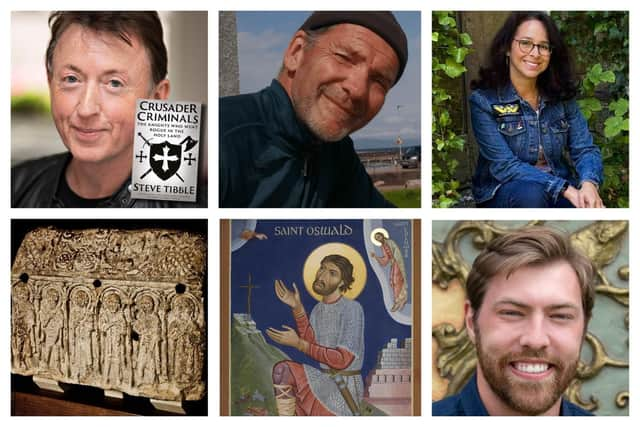

The Assassins and the Templars are two of history’s most legendary groups. One was a Shi’ite religious sect, the other a Christian military order created to defend the Holy Land.
Violently opposed, they had vastly different reputations, followings, and ambitions. Yet they developed strikingly similar strategies―and their intertwined stories have, oddly enough, uncanny parallels.
In this engaging account, Steve Tibble traces the history of these two groups from their origins to their ultimate destruction. He shows how, outnumbered and surrounded, they survived only by perfecting “the promise of death,” either in the form of a Templar charge or an Assassin’s dagger. Death, for themselves or their enemies, was at the core of these extraordinary organisations. Their fanaticism changed the medieval world―and, even up to the present day, in video games and countless conspiracy theories, they have become endlessly conjoined in myth and memory.
Henry VIII: A Legacy of Power and Blood Peterborough Cathedral, September 25 Historian, Political Theorist and Festival Director at Peterborough Cathedral, Jackson van Uden will explore how Henry VIII’s quest for absolute power—cemented by the Act of Supremacy in 1534—set a bloody precedent that echoes through history. From beheadings and burnings to modern dictatorships. Find out how one monarch’s tyranny inspired some of the world’s most ruthless regimes. Please book in advance. Entry at 6.30pm, with the talk starting at 6.45pm. Refreshments will follow after the talk and Q&As. The event will finish at 8.30pm.
Peterborough and The Mercian Kings - an in-person talk by Max Adams Peterborough Cathedral, October 8 A new history of the Early Medieval kingdom of Mercia shows how its rulers– among them the celebrated King Offa (757-796) – became the dominant force in Anglo-Saxon England between the heyday of Bede's Northumbrian overlords and King Ælfred's Wessex. Offa and his predecessors brought about something of a revolution in military, cultural and economic power. They promoted international trade, built a network of key central places and forged a new social contract between church, royal administration and people, building the foundations of the English medieval state.
Medeshamstede – Peterborough – was Mercia's first royal monastery; Guthlac of Crowland its greatest saint. In this illustrated talk archaeologist, historian and author Max Adams (The King in the North; Ælfred's Britain; In the Land of Giants and many others) shows how Mercia achieved, then lost its great power and energy and focuses in particular on the enigmatic place of the Nene Valley in its remarkable story. Seating is allocated on a first-come-first-served basis. Doors open at 7.10pm
The Hedda Stone Mystery The Knights Chamber, October 14 Step back into the world of Anglo-Saxon England and unlock the secrets of Peterborough’s Hedda Stone—one of the most mysterious and intriguing sculptures in the country.
In this captivating talk, Dr Jackie Hall and Dr Teresa Porciani will take you on a journey through centuries of speculation, examining fresh research, bold theories, and the tantalizing clues that surround this enigmatic masterpiece. What story does the Hedda Stone really tell? Who created it, and why? This is your chance to weigh the evidence, challenge old assumptions, and form your own conclusions about a monument that has puzzled historians for generations. An unmissable evening for anyone who loves history, mystery, and the thrill of uncovering the past. Teresa Porciani is an art historian specialising in the art of the Early Middle Ages (c. 500-1000). Jackie Hall is a consultant archaeologist, specialising in buildings archaeology and monastic and ecclesiastical complexes. She is the Peterborough Cathedral Archaeologist and, since 2016, the Southwark Cathedral Archaeologist. Recent publications include co-editing and contributing to Conservation and Discovery: Peterborough Nave Ceiling and Related Structures (2015) and the British Archaeological Association Transactions, Peterborough and the Soke: Art, Architecture and Archaeology (2019).
The surprising afterlife of a Northumbrian king: the cult of St Oswald and beyond An online talk by Dr. Johanna Dale, October 16 Killed on the battlefield in 642, King Oswald of Northumbria quickly became venerated as a saint and was one of the great heroes of Bede's Ecclesiastical History of the English People.
Over the following centuries, Oswald's fame spread far beyond his native Northumbria and, thanks to the acquisition of a treasured relic - Oswald's incorrupt right arm - Peterborough developed as the most important site of his veneration in England.
However, interest in Oswald was not confined to the British Isles, spreading widely across Europe and particularly in German-speaking regions, where surprising legends developed in which Oswald shares the limelight with a cheeky talking raven.
This talk will cover Oswald's veneration at Peterborough Abbey and also introduce some of the more unusual German incarnations of medieval Peterborough's favourite saint! Dr Johanna Dale is a medieval historian at University College London. She has published several essays on the cult of Oswald of Northumbria in the British Isles and is currently working on a project researching German interest in Oswald across the Middle Ages.
Zealous - A Darker Side of the Early Quakers Online Talk by Dr Erica Canela, November 20 This talk explores the origins of Quakerism in the chaos of the mid-seventeenth century in England.
Following the devastating civil wars, the population was left exhausted, traumatised, and living in a shattered landscape. In this context of ruin and uncertainty, a new religious movement emerged in the north of England. The early Quakers, driven by intense spiritual conviction, believed it was their duty to save souls at any cost. Their methods were seen by many as extreme and they repeatedly defied the authorities.
Their radical actions were expressions of deep religious zeal, shaped by fear, desperation, and a longing for moral certainty in a world that felt irredeemably broken. Dr Canela’s talk challenges the idealised image of early Quakerism, revealing a group of believers whose fervour sometimes led to deeply troubling behaviour. They stood firm in their beliefs, often risking persecution and death. In doing so, they demonstrated how far people will go, especially in times of crisis, to seek safety, truth, and divine purpose. Even when it meant crossing the line between faith and fanaticism.