
Cycling on Bridge Street: With almost no fines handed out, The Peterborough Telegraph asks if it is time to end the ban
The cycling ban on Bridge Street has been one of the most contentious restrictions in Peterborough city centre for many years.
Those for the ban have said it needs to be in place for safety issues, after a pedestrians (including this journalist) were knocked over – or narrowly missed – by cyclists on the street.
But cyclists have often said that there are no other routes through the city centre, and most simply ride through causing no issues to pedestrians.
What has become clear is that a large number of cyclists do breach the rules – the current rules of the city centre Public Spaces Protection Order (PSPO) state the cycling is currently prohibited on Bridge Street between 9am and 6pm, seven days a week.
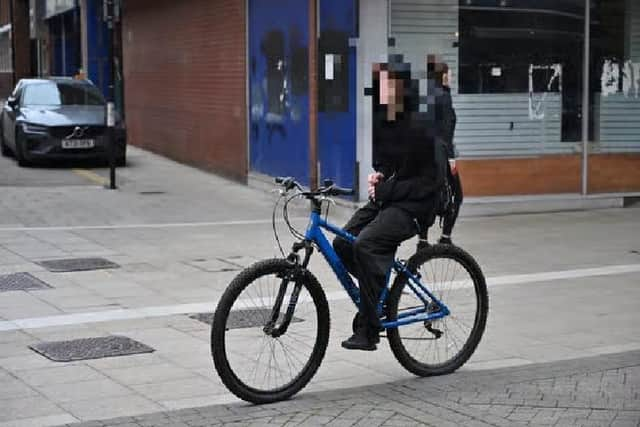

If someone is caught breaching a PSPO, authorised council officers as well as Police Constables and Police Community Support Officers can enforce the order resulting in fines of up to £1,000 or Fixed Penalty Notices (FPN), with a bill of £100.
During a recent lunchtime visit to Bridge Street, The Peterborough Telegraph saw five cyclists breaching the ban in just half an hour.
However, despite the number of people breaching the ban, statistics show that enforcement is not being carried out – with less than one fine issued every two days.
Peterborough City Council said that during 2025, just 146 fines for unauthorised cycling were handed out – and up to and including May 20 2026, just 35 had been handed out this year.
The Peterborough Telegraph asked the leaders of all the parties on the city council if it was time to end the ban, given the lack of enforcement.
While some continued to back the ban, others called for a rethink, or even a redesign of cycle routes. More enforcement was a popular suggestion.
Leader of the Labour Party and the City Council, Shabina Qayyum:
"Peterborough City Council recognises that the cycling restrictions on Bridge Street have been a longstanding and sometimes divisive issue. The intention behind the ban has always been to ensure pedestrian safety in what is one of the busiest parts of our city centre.
"However, it is clear that compliance and enforcement remain a challenge. The relatively low number of fines issued, alongside continued cycling through the area, raises legitimate questions about whether the current approach is working as intended.
“We need to strike the right balance between supporting active travel and maintaining a safe, welcoming environment for pedestrians, including vulnerable users. That means honestly looking at the evidence, listening to residents, businesses, and cyclists, and considering whether changes are needed — whether that is stronger enforcement, clearer signage, or a different arrangement altogether.
“This is not about taking a simplistic position, but about making sure any policy we have in place is practical, enforceable, and delivers the outcomes we want for our city centre.”
Leader of the Conservative Party, Wayne Fitzgerald:
"It has been proven time and time again that cyclists and pedestrians do not go well together in Bridge Street.
"It's just downright dangerous,
"I know through personal experience, and the council's administration needs to up its game and get tougher with those individuals who do not abide by the rules. More enforcement action is required, and when it is the cyclists are not as prolific on Bridge Street.”
Leader of the Green Party, Heather Skibsted:
"It has always been a controversial issue with divided opinion.
"My view is still that we need a safe cycling route through the city centre – Bridge Street could be the answer -but it would have to be structured differently with designated pathways and may be too narrow to allow this safely, although some city centres do have both pedestrian and cycle routes in one street. If this is not deemed possible, we need to find other ways for cyclists to be able to cycle from North to South of the river without having to dismount – this has not happened yet and needs to be explored further as a priority. “If there is a ban on Bridge Street it should be enforced otherwise it is not effective and currently as there is no designated “Cycle path” it is not safe for pedestrians.”
Leader of the Liberal Democrats, Christian Hogg:
“Enforcement of the cycling ban in Bridge Street has been in place for a number of years, since the introduction a number of factors have changed. I feel the time is right to review the current arrangement including the enforcement of the ban, to re look at what needs to change or for the scheme to carry on as it is.
“Having only just taken on responsibility for enforcement this week, this is one of the issues I will be looking to review with officers. We need to be encouraging cyclists to ride into the city rather that use other forms of transport, and we need to see if this ban is significant in discouraging them from doing so.
“We also need to press government to tackle the situation around e-scooters through legislation to determine what e-scooters should be legal on our roads and enforcement powers of how to deal with people that continue to ride illegal e-scooters.”
Reform UK’s Peter Reeve :
“Currently the daytime ban (9 am – 6 pm) on cycling through Bridge Street should stand, in the interests of pedestrian safety (as there is no cycle track). The Reform UK Group feel that transport needs have changed since pedestrianisation of the city centre in 1984 and that this cycling ban should be re-examined with consideration given to the provision of a new cycle track extending that currently on Lower Bridge Street.
“Bridge Street was pedestrianised in 1984. We feel that in the intervening period, transport needs in the city have changed. Some estimates have put cycling use in the city at up to 30% of our residents. A more conservative estimate was given of 10% in 2017, but this figure has since dropped by 4 per cent (i.e. now 6%). This decline may be due to a lack of cycle tracks and secure facilities to lock bicycles – bicycle theft is prevalent in Peterborough.
"Oddly, we have a very short cycle track in Lower Bridge Street, that extends from the London Road end of Lower Bridge Street to the other end, outside the Magistrates Court. There is minimal cycle parking provision at this location. The expectation appears to be that cyclists will lock up their bicycles here and then cross Bourges Boulevard to head into the city centre. However, some cyclists are chaining their bikes to the benches in Bridge Street and clearly find the current cycle parking provision inadequate and inconvenient. Approximately 400 bicycles are stolen every quarter in Peterborough (roughly 1,600 per annum), a crimewave that has been ongoing in the city for several years and which shows no signs of diminishing. With bicycle theft as prevalent as it is, we feel that many cyclists are not willing to risk losing what are expensive investments, accounting for the fall in cycling in the city.
“The new Station Quarter regeneration with its initial phase ”City Link” will see cycle tracks added from the Queensgate roundabout along Cowgate towards the city centre. The Reform UK Group at Peterborough would like to see the addition of fully kerbed cycle tracks and cycle parking along Bridge Street and Long Causeway, branching laterally across Church Street through to Cowgate and the Queensgate roundabout on Bourges Boulevard with adequate cycle parking provision.
“If we wish to increase footfall in the City centre, should we not be bold and extend the cycle track through Bridge Street and Long Causeway, up to the junction with Broadway and increase cycle parking provision? We would like to see this happen and call on council officers and the Cambridgeshire and Peterborough Combined Authority to draw-up plans and funding for such necessary infrastructure.
“With a new, fledgling university, that is successfully increasing its student intake year-on-year and commuters travelling to London and Cambridge, we feel that provision of cycle tracks through the city centre which would join with a cycle track along Bourges Boulevard (from the university to the City Link track at the Railway station) would encourage greater footfall in to the city centre, supporting these vital, local businesses.”
Leader of Peterborough First Chris Harper:
"The ban should remain and be strongly enforced by the police and our enforcement officers, it’s not about the number of fines being served but getting the message across as to how dangerous it is with regards to pedestrians and cyclists/electric scooter riders.
"The risk to children and vulnerable people such as those that are visually impaired, mobility impaired and learning-disabled is too high, some may not be able to react in time or be aware enough to avoid cyclists. It is a pedestrian designated area for a reason.”