
Civic Pride: Our ever-changing multicultural city
During the recent Fifa World Cup I was very struck by certain teams and certain players (and I don’t include Paraguay in this), writes Toby Wood of Peterborough Civic Society.
Once again Lionel Messi yet again possessed twinkly feet and balletic moves, Harry Kane was Mr Reliable and Jude Bellingham was a stand-out performer.

As usual the French played with flair and style. Kylian Mbappé demonstrated real class. But it was Michael Olise who intrigued me most. He was born in west London and played for Reading and Crystal Palace before joining the German giants Bayern Munich. Born to a British-Nigerian father and Franco-Algerian mother, he celebrates the fact that he is the product of four countries – England, France, Nigeria and Algeria - “all of which enrich me”.
A piece of basic research tells me that Olise once played against dear old Posh – on 24 July 2019, when he was 17, when his Reading team beat us 4-2 in a pre-season friendly.
Another fascinating fact is that 99 players at the World Cup were born in France but just 23 played for Les Bleus. Algeria and Haiti between them had more players born in France than the French squad.
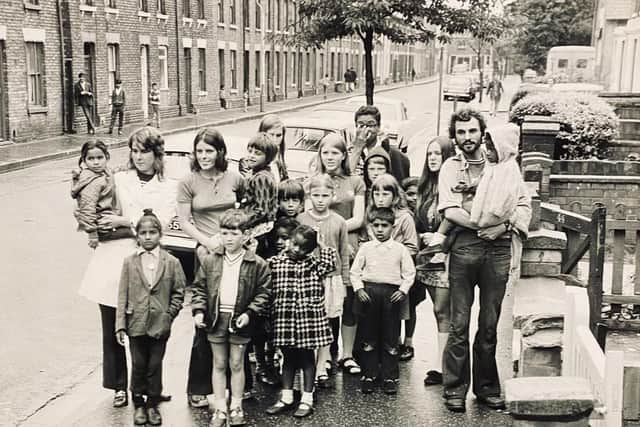
Which brings me to dear old Peterborough, a city that has a significant history of immigration over the past century. When I was at primary school I spent a few years at All Souls RC Primary School, soon to morph into the new St Thomas More School in Park Lane. There I was rubbing shoulders with Irish, Polish and Italian kids, all of whom brought a richness and culture that was different to my own immigrant stock – to Peterborough from Yorkshire and Birmingham. By far my favourite teacher was Mr Leszek Kuraś who encouraged me to write and be creative and who occasionally regaled us with stories of escaping from Hitler’s advancing forces, surviving on a diet of nettle soup, before joining the Polish Free Air Force in England.
Many of the Italian kids’ parents worked at the brick works in and around Fletton and Whittlesey.
I was chosen to be in the school football team and, whilst playing at right back, kicked the ball about three times during the entire season. We won the League at a canter, almost entirely due to Italian superstar Angelo d’Ambrosio who scored zillions of goals and eventually went on to sign professionally for Juventus in 1968 without really establishing himself as a first-team regular.
At the end of my time at Deacon’s Grammar School for Boys I was fortunate enough to be made house captain of Danes, following in the footsteps of Jamaican/English Lloyd Watson, who went on to win a Melody Maker folk/rock competition in 1972 and who appeared on the legendary Old Grey Whistle Test – look it up on YouTube!
When I returned to Peterborough to start teaching in 1972 my next-door neighbour was Jimmy Wan who owned The Great Wall, the city’s first Chinese restaurant.
During my teaching career I taught children moving to the city as part of the Development Corporation expansion – they arrived from Belfast, Glasgow, London seeking better jobs and a shiny new home. Whilst at Honeyhill Charles Swift, the then Council leader, invited quite a large number of families from Vietnam, the so-called ‘Boat People’, displaced due to the horrendous war. The school ended up with about 40 Vietnamese children, many of whom were severely traumatised by what they had seen and experienced. But my goodness they were motivated and hard workers. Indeed, within a year the school football team’s back four was Luong, Ly, Huy and Hung.
As a playleader in the Gladstone district in 1970s I worked with children whose parents had come from India, Pakistan, Bangladesh and later Uganda. I still occasionally meet some of those people in the city today.
Eight years ago I spent a week in Peterborough City Hospital and was well looked after by about 40 people. I kept a diary of the experience and noted that only about eight were what used to be described as ‘white Anglo-Saxon’ British, the rest were from Spain, Portugal, Slovakia, Slovenia, Belarus, Greece … I could go on. Without the care and attention from this Peterborough version of United Nations, dear reader, I wouldn’t be wurbling on today!
And so to today. Peterborough continues to grow and change. There is much debate, some of it confrontational and controversial, about immigration and migration. My view is quite simple, we should welcome and encourage anyone who is prepared to contribute to make this city greater. Just look at how we have arrived at today!