
TV documentary maker Alice Roberts heads for Peterborough theatre
ANYONE interested in history, archaeology, human biology or anthropology, cannot help but have been enthralled by Professor Alice Roberts.
She has captivated audiences with more than 100 documentaries, including Digging for Britain and Britain’s Most Historic Town, and has recently been filming a new series on the Roman Empire for Channel 4.
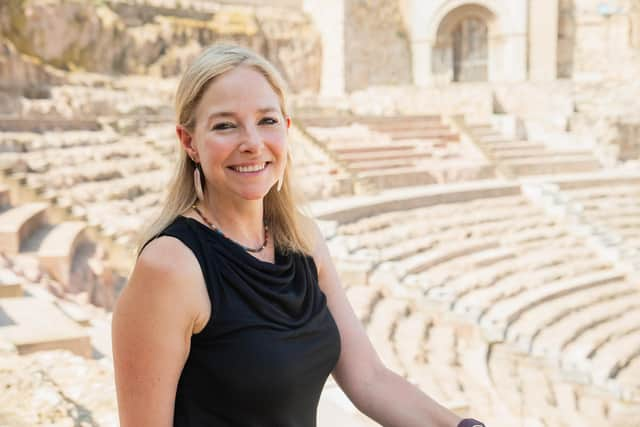

She is a bestselling author, a brilliant public speaker and now, she is embarking of a tour of the UK called Domination – the Rise and Fall of an Empire, to coincide with her latest book, of the same name – which comes to Peterborough’s New Theatre on August 29.
Professor Roberts will lead audiences on a fascinating journey across Europe, tracking the rise of Christianity, as the Roman Empire’s influence began to diminish.
So, where did the impetus behind this latest project originate?
“I’ve been looking at the way that burials and funerary practice have changed over time for ages - documenting some of those changes in my recent trilogy - Ancestors, Buried and Crypt,” she says.
“One of the questions that arises is whether you can track changes in belief systems - and indeed, political alliances - through such rituals. I’ve been surprised to discover how some rituals persisted through time. The graveside feasting rituals of the Romans are a great example, as these continued and became absorbed into the Christian calendar, as I documented in Buried. Over time, lots of observations and questions coalesced into a big question - how did Christianity spread through the Roman Empire?
“I wanted to tackle that big question using not just historical sources but archaeology as well - going on a journey of investigation to dig out the clues. I ended up looking at clues buried in ancient letters and genealogies, in new discoveries on archaeological digs - and in the meaning of symbols - in mosaics, on coins and sculptures. Reading perspectives from economists and political historians was also important. And I had conversations with lots of different academics - each of whom helped me to understand another angle in my investigation.”
For anyone coming to see her talk, she says, it will be as much of a thrilling revelation as it was for her – she really wants to take them on that amazing journey with her, from the comfort of their auditorium seats.
“I’ll be taking the audience along with me on a journey of exploration and investigation - looking at finds from archaeological sites - from monasteries and villas to mosaics and coins - piecing the puzzle together,” she says.
“There are some things I’ve discovered during my research that surprised me - and other archaeologists, even. Not to spill all the beans, I think the thing that surprised me the most is the conclusion I reached - that the western Roman Empire never really fell.”
Professor Roberts’ own journey has been a fascinating one too. She trained and practised as a medical doctor, and was then drawn into academia, starting with teaching, and then moving towards history.
“I’ve always been interested in history - and particularly ancient history,” she says.
“After I studied medicine, I practiced as a doctor and then got drawn into academia. What I expected to be just a six-month job turned into eleven years - teaching anatomy to medical students and doing a part-time PhD in biological anthropology – studying ancient bones. You can’t study bones without being interested in the wider historical context. I enjoy all the strands of my career and feel very lucky to be exploring ideas I find fascinating with an enthusiastic audience. The different aspects of my work might seem quite separate, but they all flow together. I started writing because of television, and I started doing television because of my academic work, by writing bone reports on Channel 4’s Time Team, many years ago.”
If she could travel back in time, she says, she would like to go and find out more about the Dark Ages in Britain, around the years 500 to 1000 CE – “We have so little documentary evidence from these important centuries, but archaeology and archaeological sciences are helping shine a light on that period” - but what about any archaeological finds she would have like to have been on site for?
“I’m lucky to see many extraordinary archaeological finds in the course of my work – particularly when making television series about history and archaeology,” she says.
“I have just been filming a new series about the Roman Empire for Channel 4, and I visited the wonderful Underwater Archaeology Museum in Cartagena, southern Spain - where archaeologist Rocio Castillo showed me one of the recently conserved wooden boats that had been excavated from the seabed near Mazarrón. It’s Phoenician - around 2700 years old - I would love to have seen that emerging from the sand! The Phoenicians play an important role in the backstory of the Roman Empire.”
Alice is fascinated by the interplay between people and culture: Does she think people have changed over the course of history? “I think people are essentially very similar - but we are all products of our culture,” she says.
“It’s amazing to read letters written by people centuries ago and see the full range of human interests and emotions expressed in them. I loved reading the letters of the fifth-century Gallic bishop and poet Sidonius when researching Domination - and I’ll be sharing some of the insights from those on the tour. He writes a beautiful letter to a friend, describing his countryside villa in detail - he’s clearly very proud of it. He’s also very good at flattering the Visigoths when they seize power in Gaul.”
As well as history, science and archaeology, Professor Roberts is a lover of art, enjoying watercolour painting herself, and nature. Her favourite artist is Henry Moore, she says – “I have always loved the way that he reimagined natural forms as monumental statements - somehow capturing the essence of things,” – and she enjoys walking.
“I especially love a walk that combines natural beauty and some heritage,” she says.
“My two children are very familiar with my ‘monumental walks’! But I also love to immerse myself in nature, literally - swimming in the sea and rivers, and kayaking – small boats were probably the most ancient form of transport. It’s very quiet and contemplative - the dip of the paddle in the water, the cry of oyster catchers, the view of the coast from the sea - it soothes my (humanist) soul.
“I love travelling and spend a lot of time away making documentaries. Probably the most interesting site I’ve been to is Gobekli Tepe in Turkey - a pre-pottery Neolithic site with enormous carved stones arranged in circles - a hunter-gatherer temple, perhaps.”
Professor Alice Roberts will be bringing her new show Domination – the Rise and Fall of an Empire to the New Theatre, Peterborough on Friday 29 August, 7.30pm, tickets from £35.
For more information and to book visit: https://newtheatre-peterborough.com