
WATCH: Wheelchair user from Peterborough reveals numerous accessibility failures on rail journey to London
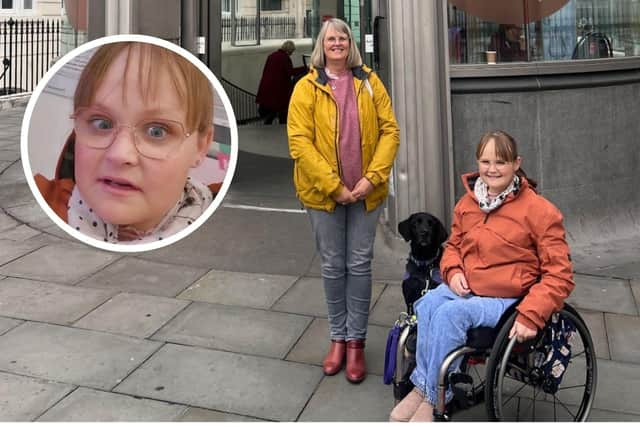
A wheelchair user from Peterborough has revealed the reality of travelling on public transport after attempting a ‘simple’ journey to London’s Trafalgar Square.
Harriet Little, who has a spinal cord injury, says what should have been a straightforward trip became a series of accessibility failures.
Her journey formed part of the Spinal Injuries Association’s (SIA) nationwide ‘Travel With Confidence’ campaign challenge, funded by the Motability Foundation.
Travelling with her assistance dog and her mum, Harriet was one of six people with spinal cord injuries from across the UK challenged to plan and complete a journey to central London within 48 hours, using at least two forms of public transport, including trains, buses or the tube.

A spokesperson for SIA said: “While such a journey may feel routine for many, for disabled passengers it can demand extensive planning, constant problem‑solving and significant emotional resilience. Each participant was required to map their own route, navigate unexpected barriers, and document their experience using video diaries and a detailed scorecard to assess accessibility at every stage.”
An exhausting journey marked by failure
Despite careful planning, Harriet encountered what the SIA called “repeated and distressing barriers”, detailing the following:
• Extreme stress at every stage – Harriet rated her stress levels as 10/10 at two stages of her journey; during the planning process, driven by a confusing system and previous experiences of being let down, which caused significant pre-travel anxiety, and during the train journey itself.
• No accessible toilet provision – The train's accessible toilet was completely out of order, with no alternative available, removing Harriet's ability to travel with dignity or confidence.
• Poor communication and support – At Peterborough station, passenger assistance staff placed Harriet in a carriage without communicating which one to her mum. Despite Harriet clearly stating in advance that she required a companion seat, staff did not ask other passengers to vacate a seat, leaving her separated and unsupported at a critical moment.
• Misleading accessibility signage – At London City Thameslink, signage claimed 'wheelchair access' that did not exist. Harriet was unable to book an Uber due to the presence of her assistance dog, and found no accessible taxi rank. When a taxi was eventually sourced, the meter started running before she was fully inside the vehicle.
• Significant time and cost penalties – Harriet's journey took up to 50 minutes longer than predicted for a non‑disabled traveller, becoming an exhausting ordeal with delays and detours at multiple stages.
Ultimately, Harriet was unable to complete the challenge as intended.
The spokesperson went on: “With no step-free access at Charing Cross tube station or at nearby stations, including Piccadilly Circus, Embankment and Leicester Square - despite the area being a central tourist hotspot, and with insufficient time to reroute by bus, she had no choice but to take a £52 taxi instead. Her total journey cost £80.80, compared with £28.80 for a non-disabled traveller - almost three times more expensive, purely due to inaccessible infrastructure.”
Using the campaign's scorecard system, Harriet rated her journey an average of 5/10 overall, the lowest score among all participants. Of the six people taking part nationwide, five encountered critical barriers that prevented them from completing their journeys.
Reflecting on her journey, Harriet said: "More needs to be done to create a public transport system that actually works for wheelchair users – one that's efficient, reliable and doesn't require hours of contingency planning just to leave the house. Disabled people shouldn't have to budget extra time, money and stress simply to make the same journeys as everyone else.
“The toilet being out of order for example, if you could walk, you would be able to get to the next toilet – but if you're in a wheelchair, you can't use the loo. One broken facility can make an entire journey impossible."
A spokesperson for the Rail Delivery Group said: “Everyone should be able to travel by train safely, confidently and with dignity. We know that sometimes that doesn't happen, but the rail industry is committed to improving accessibility across the network.
“Improving accessibility remains a priority, and we are working with customers, accessibility groups, frontline staff through disability awareness training, and industry partners to deliver meaningful improvements. This includes strengthening services such as Passenger Assist and Turn Up and Go and working with the Government to deliver further improvements as set out in the accessibility roadmap.”
Transport that leaves people behind
The SIA says this challenge “highlights issues affecting a significant proportion of the UK population”.
The spokesperson said: “There are an estimated 105,000 people living with spinal cord injuries in the UK, alongside 7.5 million people with mobility impairments that may restrict independent travel. SIA's annual What Matters survey found 71% of respondents reported challenges with public transport, with the most common barriers being poor platform access, lack of level access at stations, and the need to pre-book assistance.”
Chelsea Fleming, Programme Director at the Motability Foundation, said: "This research shows the significant challenges that wheelchair users and people with limited mobility face using public transport. At the Motability Foundation we are committed to supporting robust evidence that highlights where barriers persist and what action is needed to address these. Only with this insight can we work towards a transport network that is genuinely inclusive, and supports transport equity."
An accessibility lottery for disabled travellers
The campaign exposes what SIA describes as an 'accessibility lottery', where disabled passengers face dramatically different experiences depending on where they live and travel. Even participants who scored journeys at 7–8/10 still encountered single barriers that were severe enough to derail their plans.
SIA is calling on people to share their experiences by writing to their local MP and posting on social media using the hashtag #AccessibleTravel.
The spokesperson added: “By adding their voice, passengers can help build a clearer picture of accessibility nationwide and strengthen the call for meaningful change.”