
The 'local' sea monsters that lived in Dogsthorpe and Hampton millions of years ago - and are now back at Peterborough Cathedral
Jamie from Fossils Galore in March reveals the secrets behind the giant sea reptiles that lived ‘in Peterborough’ when dinosaurs ruled the world
Peterborough Cathedral’s Monsters of the Sea exhibition has enthralled and captivated scores of visitors already this summer, as families are transported back millions of years to a time when dinosaurs ruled the land – and terrifying giant reptiles roamed the oceans.
But what the visitors to the exhibition may not realise, is that many of the creatures featured in the exhibition made their homes here millions of years ago – when the land where Peterborough now sits was under an ocean.
These huge monsters feasted on fish and other sea creatures that also made their home in this part of the world – as Peterborough was underwater for millions of years.


To find out more about the lives of these remarkable beasts, The Peterborough Telegraph spoke to palaeontologist Jamie Jordan, from Fossils Galore Museum in March.
Iconic creature one of Jamie’s first fossil finds
Jamie, who is from Peterborough, has discovered fossils of many of the creatures in the exhibition, including the Plesiosaur that lived around 160 million years ago.
Jamie said: “We would have likely had these swimming in pods around this area during the Jurassic time. They would have been feeding on animals like fish and other crustaceans that were swimming around like ammonites, crabs and lobsters and trilobites.

"This was one of the first major finds of my career – I was only 16 at the time when I discovered a plesiosaur skeleton at a gravel extraction site just to the north of Peterborough.”
While the plesiosaur might be one of the most famous sea monsters – they are not dinosaurs – that lived in our neck of the woods, it was not the most fearsome.
Jamie said the pliosaur was the biggest predator living in the sea at the time.
He said: “It would have been eating animals like the plesiosaur and opthalmosaur as a snack. It would have been 12 metres to 16 metres long.
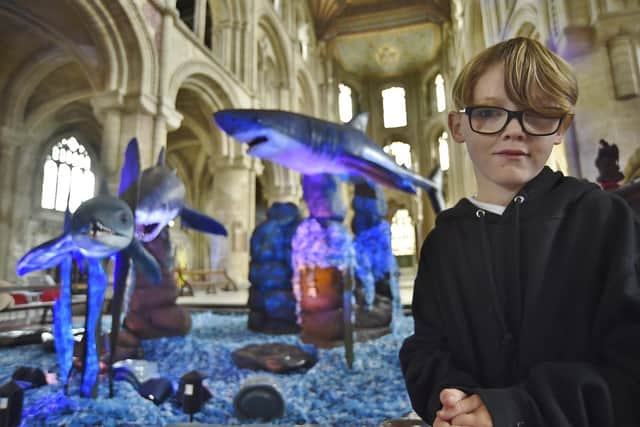
"If we looked at the sediment under the Cathedral now, we would have a very good chance of finding evidence of this animal being around – just imagine going back to the Jurassic times, it was a subtropical sea with islands dotted about, and we would have had these animals chasing other reptiles.
"We have found a few teeth and vertebrae of these animals around here – they are some of the rarest fossils to come across. There were fewer of these about than plesiosaurs and opthalmosaurs, but when you do come across them, you can see the characteristics of a real ferocious animal of the time.”
Some areas around Peterborough were part of a deep ocean
Some of the reptiles living in ‘Peterborough’ provided key evidence on how marine life has evolved – and continues to evolve – now, with some species showing elements of how dolphins look and move in the ocean.
Jamie said: “The opthalmosaurus, an icthyosaur-like creature, that would have been prey to pliosaurs and sometimes the odd plesiosaur would have been preying on these animals.
“We know this is a deep sea animal – we know some areas around Peterborough that were quite deep ocean – we can see that from the ‘pineapple ring’ of bone that is inside the eye socket of this animal – it needs that so it can dive quite deep down to escape predators and hunt for its food.”
Jamie said that Peterborough’s geological make up made it an incredible place to find fossils. He said: “We are very lucky to have something that I nicknamed years ago ‘the hidden Jurassic area,’ a clay formation which extends from Dorset, through the middle of Peterborough up to Yorkshire and the Jurassic coast there, and up to Scotland.”
Along with the giant reptiles, also featured in the Cathedral exhibition is a giant ammonite – something that might be very familiar to young dinosaur enthusiasts. Although the giant ammonites were not found directly in Peterborough – although the smaller ones did, their giant cousins didn’t live far away, with some larger ones having been found in Hunstanton.
Jamie said: “Ammonites would have been swimming around Peterborough during the Jurassic times. If you go over to the brick pits of today, you will find hundreds, if not thousands, if not hundreds of thousands of these animals just in the shales around this area. We would have had 30-40 different species living in one formation.”
Plea for help to create national centre
Fossil’s Galore in March has been going from strength to strength in recent years – and this summer has a range of activities for families to take part in.
However, Jamie and his team are looking to move on to the next stage – a state of the art ‘National Centre for Pre-History’ here in Peterborough.
"When I was 13, I set up Fossils Galore as an educational website about what lies beneath our feet. I wanted to educate the world on my interest and what I had discovered over the years.
"We set up fossil hunting trips when I was 16, they were very popular, and I built up such a big fossil collection that it needed to be housed in a museum, so I set up my first museum at the age of 18, and it has gone from strength to strength.
"We have had to keep moving as we keep outgrowing our premises. It is now in March at the moment, which is no longer just a museum – it is a museum and educational activity centre, so we can make it more educational, more fun and a better learning resource, not just for nuero-typical people, but also for nuero-divergent as well, like myself – I have struggled from day one with dyslexia, and I have used that to my advantage to take things forward, and open up a place which is beneficial to people with the same sort of condition as myself.
"If you’d like to see what these animals look like, just their bare bones, you can come and see them, and the land animals of the time, at Fossils Galore. If you are a dinosaur fan, we have a dinosaur being cleaned up live on display.
"I’d like to open up a much bigger premises where we can offer much, much more. Where we can have a bigger preparation laboratory. With finds coming out of the field quite often, we need a better premises to prepare those specimens to have them ready for display, whilst also educating visitors.
"We would also like to have a bit more museum space so we can show off our collection, make it more educational, so it shows what is being found around the Peterborough areas.
"We are looking at around one to one and a half million pounds – we are looking for help from the council, and anyone who can help.”
Anyone interested in helping Jamie out – or for more information about Fossils Galore, can email [email protected] or call 01354 278089 or visit www.fossilsgalore.com
There are also a range of activities taking place at Peterborough Cathedral connected to the Monsters of the Sea exhibition – for more details, or to buy tickets, visit https://www.peterborough-cathedral.org.uk/