
Painstakingly stitched embroidery recreating medieval ceiling of Peterborough Cathedral is revealed

A carefully hand-stitched embroidery recreating the medieval painted Nave ceiling of Peterborough Cathedral was unrolled today for the first time since work began eight years ago.
The painstakingly crafted embroidery contains more than 1.5 million stitches and measures about 12 feet two inches long.
It is a large-scale needlepoint interpretation of the Cathedral’s thirteenth-century painted ceiling, one of the most important surviving examples of medieval decorative schemes in England.
Seven volunteers began stitching in May 2018.
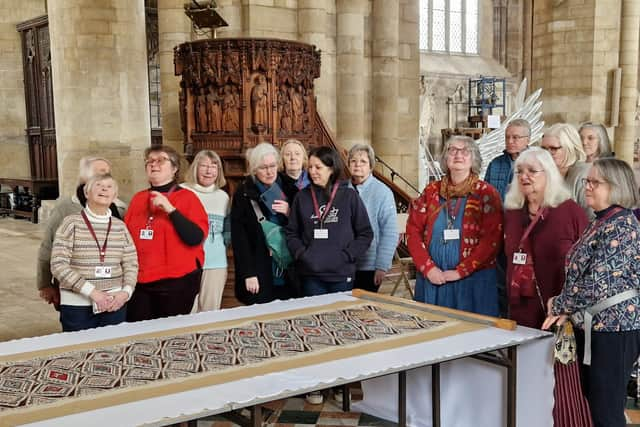

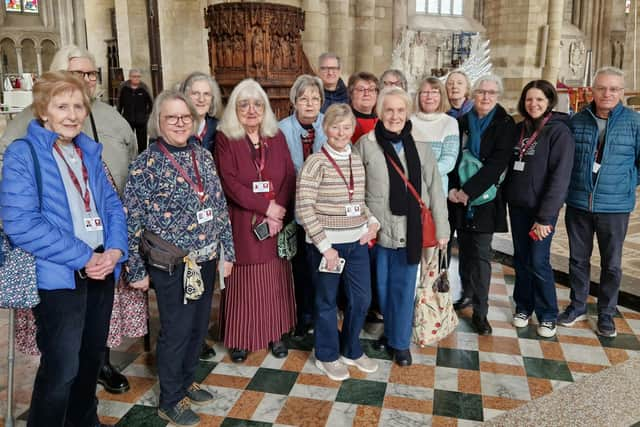
Today more than 20 embroiderers, men and women work in five weekly sessions, with around 80 visitors and clergy contributing at least a stitch.
Despite some early setbacks, which included rotated pattern charts and alignment challenges caused by the fine canvas, the team has now completed approximately three-quarters of the embroidery.
It was originally feared the work would last for 70 years but now completion is expected within the next year.
The Very Reverend, Chris Dalliston, Dean of Peterborough said: “Peterborough Cathedral’s painted medieval ceiling is a unique and extraordinary work of art.
"Our wonderful team of embroiderers have over the last few years, recreated this treasure through a skillful, patient, and painstaking process that honours the original but also represents its historic imagery in a new medium and a new way, a work of art in its own right.”
The entire canvas has been unrolled so the team can return to the beginning and complete part of the border that was not fully understood at the start of the project.
For many volunteers it was the first time they have seen the earliest sections.
After the border is corrected, the work will be re-rolled so the final lozenge can be finished after which the Cathedral will begin planning how the completed masterpiece will be displayed.
What was the inspiration behind the embroidery?
The embroidery was originally commissioned in 1986 from the Royal School of Needlework by local supporter Mrs Freeman, who had close connections with the Cathedral.
Mrs Freeman died in 2008, aged 90, without starting the project.
After passing through several hands, the materials were finally gifted to the cathedral in 2018, the 900th anniversary of its foundation.
The design is based on William Strickland’s 1849 lithographic drawing of the medieval painted ceiling.
As the embroidery has progressed, small adjustments have been made to match the real ceiling more accurately including correcting the famous upside-down goat, monkey and owl panel and refining the organistrum player.
The canvas, woven at 18 threads per inch, allows extremely fine detail.
What does the design include?
The design includes kings, bishops and saints.
But there are also representations of The Seven Liberal Arts (Grammar, Logic, Rhetoric, Geometry, Arithmetic, Astronomy and Music), The Agnus Dei and Saints Peter and Paul, Mythical and comic creatures including a wyvern, harp-playing donkey, pig-like ogre, Janus and a human cannibal, and the famous goat carrying a backwards-riding monkey with an owl.
Scholars believe the shift from sacred imagery to humorous beasts may reflect the division between the Nave, where townspeople sat, and the Quire, where monks worshipped - a medieval visual joke for the clergy.