
'It ripped our family apart'- Peterborough mother warns of the dangers of slapped cheek after being told her unborn baby would not survive after contracting the virus
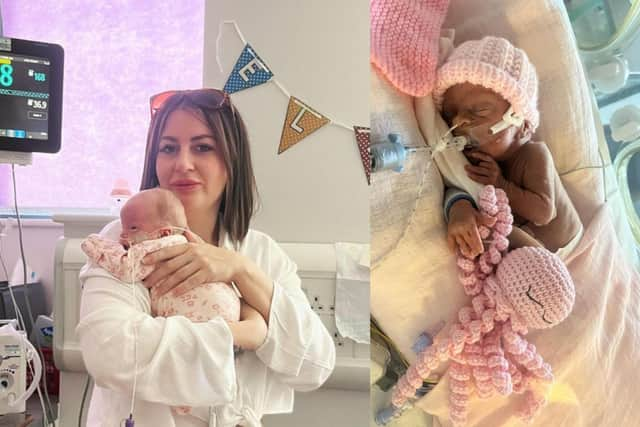
Baby Elsie defied the odds to survive her battle with Hydrops but doctors had told her parents to expect a still birth.
A mother from Peterborough has launched an awareness campaign to educate parents over the dangers of slapped cheek- especially for pregnant women after a case in her daughter led to her being told that the baby she was carrying at the time would be a stillborn.
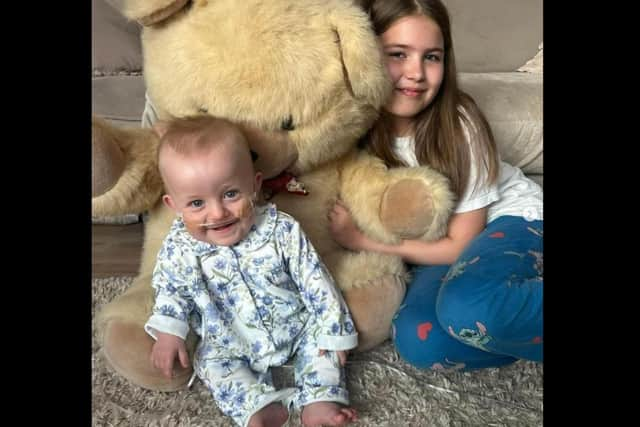
Fortunately for Zoe Ellard, from Eye, baby Elsie (now 15 months old) defied the odds to survive after a case of slapped cheek in her daughter Maddison (8 at the time, now ten) caused months of hospital stays as well as her to be told on several occasions by doctors that her baby would not survive.
Slapped cheek syndrome (Parovirus B19) is most commonly seen in children with symptoms including headaches, a high temperature, a runny nose and sore throat as well as a red rash on one of both cheeks, for which the syndrome gets its name.

It spreads through droplets produced by coughing or sneezing but can often be missed or can be assumed to be something less serious if some symptoms do not present. Often, the red cheeks only appear after the infection has run its course.
Slapped cheek can be particularly dangerous for pregnant women as it can infect the fetus with another serious condition called Hydrops fetalis.
This causes large amounts of fluid to build up in the tissue and organs of a baby and causes extensive swelling. Around half of babies who contract Hydrops do not survive.
‘Regulations need to change’
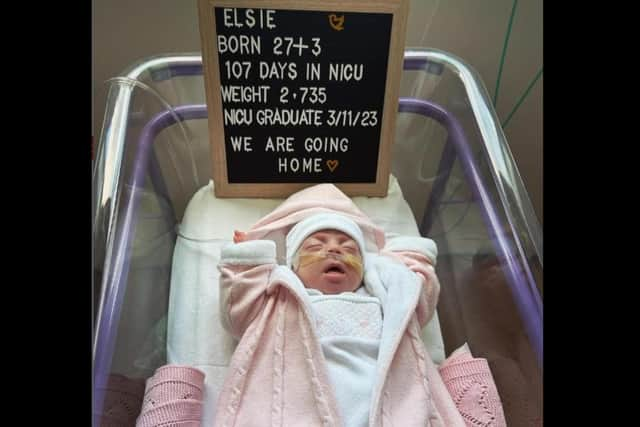
Zoe is one of the lucky mothers who saw their child survive and has now shared her story to raise awareness to others about just how serious the condition of slapped cheek and push for a change in guidelines.
Zoe said: “Regulations need to changed and women need to be offered these blood tests. Slapped cheek is on the rise and nobody realises how dangerous it is to pregnant women and their children.
“It’s unbelievable that guidelines still exist that tell parents that they can send their children to school with slapped cheek.
“Elsie wasn’t expected to survive delivery and we spent three or four months in neonatal intensive care in Leicester away from Maddison and it could have been a lot, lot worse.”
Zoe contacted Peterborough City Hospital at the beginning of July 2023 to say that Maddison had contracted slapped cheek.
She said: “I was aware that it was potentially dangerous to pregnant women and I was told that the midwife wasn’t sure if I needed to be seen and that she would check with the consultant.
“I was then told that it was so rare that a woman my age would not be immune to slapped cheek that I would not need a blood test but I could request one from my GP to make myself feel better if I wanted. I said ‘good luck with that as I can never get through to them but I was reassured I would not need it.”
‘Had I gone to hospital a few hours later, she would have been a stillborn’
Two weeks later, however, Zoe rang the hospital’s NHS helpline for pregnant women to say that she felt very, very big and heavy despite being only 25 weeks pregnant and she knew this did not feel right due to her previous pregnancy only to again be told this was normal pregnancy.
It took Zoe sending a recording of her baby’s heartbeat to a midwife at the hospital, who told her to go to the hospital, to prompt Zoe to ring again and she insist she was seen before she was admitted to hospital.
It was then that tests led doctors to conclude that her baby had Hydrops as well as establishing that Zoe had entered pre-term labour.
This meant that she was blue-lighted to Luton and Dunstable University Hospital, where she was told that her baby had fluid on her brain, her heart and her stomach and her organs were failing, meaning that she would not survive.
Zoe added: “The main goal was to get me to Luton hospital. where the fetal medicine team would assess the situation. When we got there, we were told we were being blue-lighted to King’s College Hospital in London the next day and it was touch and go whether my baby survived the night.
"We got the London to be told that Elsie’s blood count was two (normal range is 14-24). We were told that had I gone to hospital a few hours later, she would have been a stillborn.
"While in the womb, doctors carried out two blood transfusions to the umbilical chord to try and save Elise’s life from over a period of two weeks. I was staying at Luton but being transported backwards and forwards to London.
"We were told the treatment was working but not as well as they had hoped and I was preparing to give birth to a stillborn.
"I was told that it was very unlikely that she would survive delivery but that the best path to survival was for her to be born in a hospital with a level 3 intensive care unit (Peterborough is only level two).”
‘I too was suffering from mirror syndrome’
While all this was going on, Zoe herself was suffering from mirror syndrome which meant that she also contracted a number of Elsie’s symptoms, including heart failure and liver problems.
Given the news that she was very likely to give birth to a stillborn, Zoe discharged herself on July 20 to spend time at home with Maddison and her family only to go into labour that day and had to be driven back to Peterborough City Hospital.
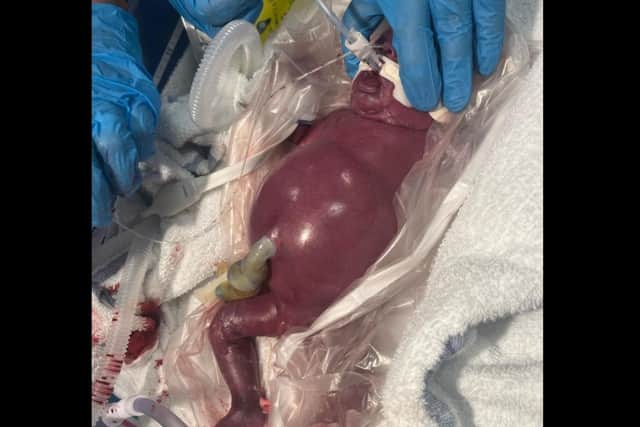
The team managed to deliver Elsie and ventilated her upon delivery but Zoe was still told that it would be a few hours wait to see if she would survive.
Eight hours later, the family were transported to Leicester Royal Infirmary and remained there for six weeks, while Elise fought but ultimately won her battle for life. She was then moved back to Peterborough before finally being discharged
She was born after only 27 weeks via a breach birth due to a placental abruption.
Elise still has Parvovirus in her blood, it is asymptomatic and not contagious but doctors are still waiting on the results of further tests if her immune system is compromised.
Zoe added: “I have campaigned relentlessly. I have posted on social media, contacted schools just to say don’t be naive about it, this is what slapped cheek can do. Everybody warns you about chicken pox and the effect it has on pregnant women but nobody talks about slapped cheek.
“When I came back to Peterborough, I was told that none of the neonatal intensive care units nurses had ever even had a baby in there with Hydrops and everybody in thee told me how much a miracle she is. When she was born, nobody knew how to treat her.
“When Elsie was born, we were told that she was the only baby in the UK that had it to the severity that she had and to survive. Staff at Leicester and Peterborough had to consult with Great Ormond Street over her care and even research cases in America and India. We were very, very lucky.
“I just want people to realise how dangerous slapped cheek is. We nearly lost Elise and it ripped our family apart.”
Zoe has shared both her and Elsie’s journey on Instagram via her account hydrops_and_elsie.