
Father and son treasure hunters unearth mysterious gold artefact in Lincolnshire
The find has left experts “baffled”
A rare gold artefact, thought to date back over a thousands years, has been discovered near Spalding.
Andrew Geoghegan and his 12-year-old son, Arthur, unearthed the intricate piece during a metal detecting session in Quadring.
With Andrew being an award-winning jewellery designer, the find proved to be both exciting and apt.


Recounting the day of the discovery, Andrew explained: “During a bonding trip with my son, Arthur, we unearthed a rare and mysterious gold artefact which has all the signs of being Anglo-Saxon.”
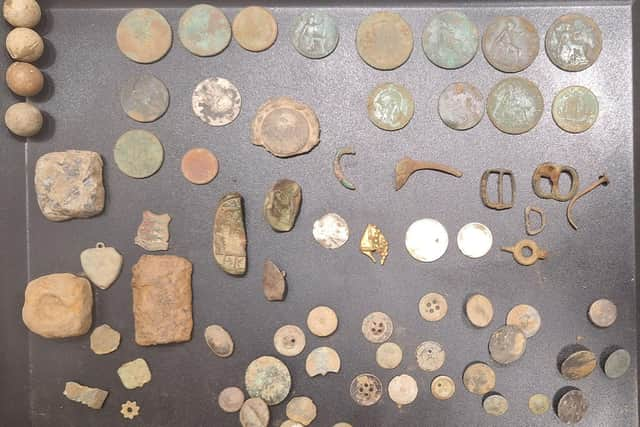
The session was organised by Lincolnshire-based detectorist Martin Stokes, of Digging History UK. After three days of metal detecting with a group of others, several old coins, buttons and other non-valuable objects were unearthed. But then Andrew’s luck turned as his detector picked up an unusual signal.
“Everything got really quiet and serious,” he said. “It was the last day of our trip, and the detector gave a low signal that usually means iron or modern scrap. But for some reason, I decided to dig – and as soon as I saw the gold glinting in the soil, my focus became razor-sharp.
"It was an incredible moment. A lost piece of history had just resurfaced.
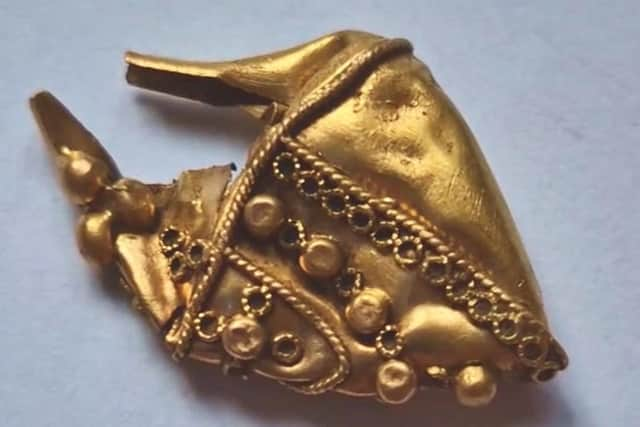
“The artefact is quite breathtaking and features intricate twisted wire detailing and gold granulation patterns. As an award-winning jewellery designer it’s already inspiring in me new creations that pay homage to ancient artistry.”
"This incredible find adds to the region’s rich history and legacy of archaeological treasures.”
While it is thought the object could be a chape – the metal tip of a dagger’s scabbard – nothing has yet been confirmed with Andrew claiming the “experts are baffled”.
Measuring 2.5cm in height, it appears to have been hollow, but since flattened – perhaps due to centuries of soil and plough pressure.
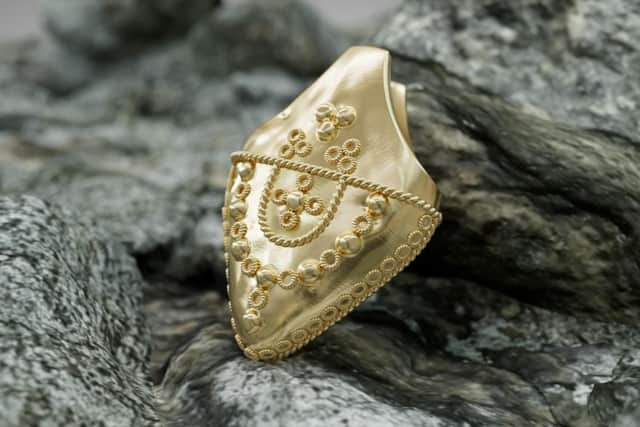
Andrew claims its rich gold colour “suggests it is made of 20-23ct gold, almost pure”.
Lincolnshire is no stranger to archaeological treasures, with its rich history dating back long before Roman times. The county’s vast areas of agricultural land also add to its reputation as a hotspot for archaeological finds.
“Metal detecting is more than just searching for objects; it’s about being in the moment, learning from history, and enjoying the thrill of discovery,” said Andrew.
The gold artifact is currently with the Finds Liaison Officer (FLO) via Peterborough Unitary Authority, where it will undergo further analysis.
If classified as treasure under the Treasure Act 1996, it could be acquired by a museum for public display and study.
Andrew went on: “In terms of its function, there is a chance it is a chape from a dagger’s scabbard, but experts are currently baffled as it doesn’t fit the existing knowledge of this item.”
Andrew, who lives in Portugal, collaborated closely with one of his CAD designers to produce a rendered image depicting how the artifact may have originally appeared - and is already sketching and developing concepts for a new jewellery collection inspired by the find.
The expedition was made possible thanks to Martin Stokes, of Digging History UK. Along with being a passionate advocate for responsible metal detecting, Martin is also deeply involved in fundraising for Combat Stress – a UK charity supporting veterans’ mental health.
“Finds like this are incredible,” said Martin. “But what’s even more important is the community we build – whether it’s connecting with the past or supporting those who have served.”