
US Air Force pilot praised for action to avoid mid-air fighter jet collision above skies of Peterborough
A United States of America Air Force pilot has been praised for his actions taken to avoid a mid-air collision over the skies of Peterborough between two fighter jets and a light aircraft.
On Thursday January 8, 2026, two McDonnell Douglas F-15 Eagle fighter jets were passing over the east of Peterborough- at around 3,000 feet- on their way back to RAF Lakenheath from completing training missions when they spotted a DR360 light aircraft on their radar.
The lead jet made the direction for both to turn 10 degrees to the left to avoid the collision but then, in a break in the weather, the second pilot noticed that the planes were still on a collision course and instructed both to turn 30 degrees left.
The flight report- created by the UK Airprox Board- noted that “it was fortuitous that the weather broke enough to sight the other aircraft given the collision course.”
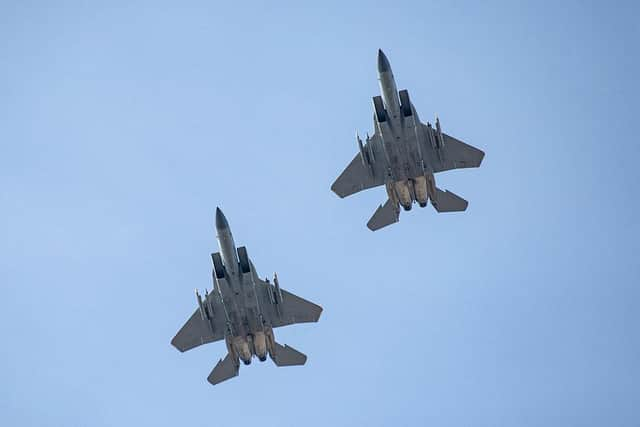

The US planes on a ‘deconfliction service’ and were therefore relying on radar to avoid traffic in the air given the weather.
An investigation was completed by the RAF Lakenheath Radar Chief Controller and has since been released to the public.
It found that “The F15 and D360 pilots shared an equal responsibility for collision avoidance and not to operate in such proximity to other aircraft as to create a collision hazard.
"If the incident geometry is considered as head-on or nearly so then both pilots were required to turn to the right.”
The investigation board went onto praise the actions of the lead fighter jet pilot for their swift actions.
The report stated: “The board discussed the F15 lead pilot’s actions and commended them for having taken positive control, both for themselves and for the trail F15, when they had detected the DR360
using on-board sensors.
"They had sufficient situational awareness of the DR360 to have taken effective action for both formation members, in contrast to the DR360 pilot who had had no situational awareness on the F15 formation until they had sighted them.
"Members wondered why the DR360 pilot had then maintained course and altitude and had closed to
within a mile of the lead F15, the pilot of which had reported being in cloud and who had consequently not seen the DR360. The board wondered whether the DR360 pilot had seen the lead F15 at all.
“Turning to risk, the board members agreed that the lead F15 pilot had taken sufficient action to avert any risk of collision.”
The incident was closed as a Category C, no risk of a collision.