
Civic Pride: What next for the iconic Guildhall?
‘Iconic’ is a word that is often overused, writes Toby Wood of Peterborough Civic Society.
Winston Churchill is often cited as an iconic Englishman. If you were to think of iconic English buildings you might include Stonehenge, the Tower of London or Buckingham Palace.

I asked an AI app to give me the names of iconic people born in Peterborough. The answer came back - John Clare (poet), George Alcock (astronomer), Aston Merrygold (singer), Jake Humphrey (TV presenter), Louis Smith
(Olympic gymnast), Peter Boizot (entrepreneur), Andy Bell (musician), Lauren Steadman (Paralympic athlete), Robert ‘Old’ Scarlett (sexton) and Adrian Lyne (film director).
Adrian Lyne - who? Well, dear reader, Mr Lyne
directed the films Fatal Attraction, Flashdance and 9 ½ Weeks, so there! We all learn something new, including me!
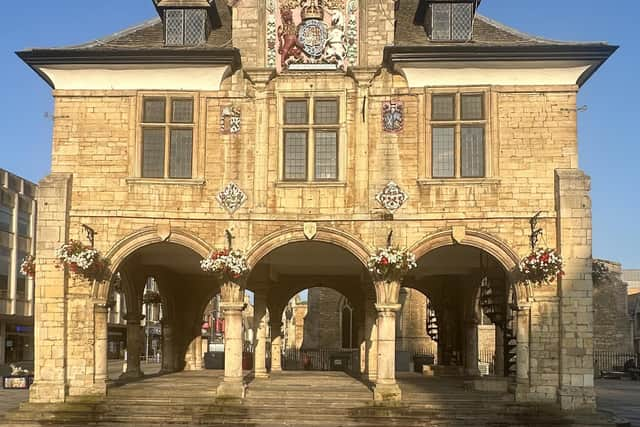
Ask AI to name Peterborough buildings and you get the Cathedral, Longthorpe Tower, Thorpe Hall, St John’s Church, Wortley Almshouses, Peterscourt and the Guildhall. And it’s the Guildhall that is the Peterborough icon that I would like to concentrate on here.
So, what exactly is the Guildhall? Peterbororians walk past it just about every time they visit the city centre, perhaps without knowing much about it.
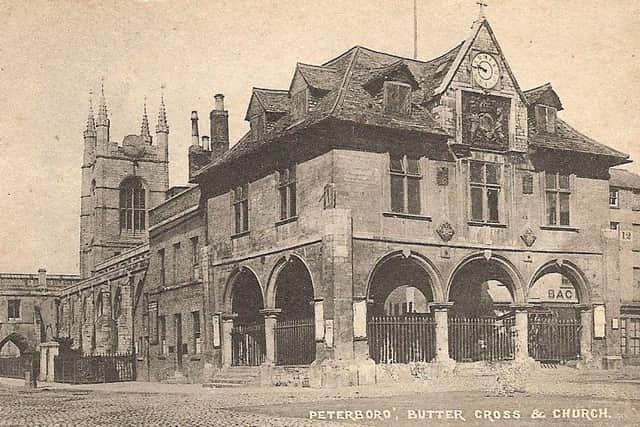
The Guildhall (or Old Guildhall or Market House as described by architectural historian Niklaus Pevsner) was built over 350 years ago, in 1671 from ‘warm local limestone’ by leading local builder and master mason John Lovin and was deliberately built facing the Cathedral gatehouse. It stands on, or close to, the site of a covered ‘Butter Cross’ and it is believed that the ‘Chamber over the Cross’ replaced an earlier timber framed Moothall and Guildhall (probably timber-framed, arcaded buildings in need of repair) standing on the northern side of the square.
It is likely that the city’s feoffees (legal owners of the land) decided to build the Guildhall as a celebration of the restoration of Charles II and it is known that the project was funded by public subscription. The building is Grade II listed and, as a place in which the Council held some of its meetings, was superseded when the Town Hall opened in 1934. Prior to that it had been restored in 1929. The upper floor of the building, which can only be accessed by a steep spiral cast iron staircase, was used for small group meetings in living memory but is now unused due to its fragile state.
The Guildhall bears a striking resemblance to the Old Town Hall in Amsterdam as depicted in the 1657 painting ‘The Oude Stadhuis in Amsterdam’ by Pieter Jansz. The picture was bought from the painter in 1658 for 300 guilders by the mayor of Amsterdam for his office in the New Town Hall. It now hangs in Amsterdam’s Rijksmuseum.
Postcards and photographs from a hundred years ago show iron railings enclosing the Guildhall. These are now long gone and the ground floor is now open on all four sides and is occasionally used as a temporary performance space when various festivals or special events are held on Cathedral Square.
Recently the Guildhall has once again been the subject debate and discussion. The Council plan to block off the spiral staircases at the corner of the building to prevent further vandalism and damage and many of us certainly don’t like the look of the temporary fencing placed to try to deter further mutilation. Indeed Peterborough Positive,
lead by Pep Cipriano, has plans to make any temporary fencing as attractive, interesting and informative as possible. Watch this space – literally!
The Civic Society urges the City Council to explore ways to use the building again – and even to possibly enclose the lower floor again so that it might be equipped as a more permanent performance space or as a civic space e.g. tourist information centre. A possible solution would be to install a glass cube inside the building, thus avoiding the need to fix anything to the fragile structure itself. Of course any improvements would be costly but
surely some solution could be found and funding sought. This could be exactly the sort of project that the Cambridgeshire & Peterborough mayor, Paul Bristow, could adopt. Now is the time for positive ideas and that ‘glint in the eye’.
Whatever happens to the Guildhall in the future it remains an iconic historic building right in the heart of the city.
There – that word again – iconic!
********
On Monday 13 October the Civic Society’s monthly talks is ‘Peterborough Positive: its role and aspirations’ by Pep Cipriano, the Chief Operating Officer of Peterborough Positive.
Pep is Peterborough born and bred and is well known throughout the city for his dynamism and positive ‘can-do’ attitudes.
We are at our usual venue of St Marks Church Hall, Lincoln Road, Peterborough, PE1 2SN, starting at 7.30pm. Non-members are welcome but we rely totally on subscriptions and donations, therefore we request that a donation of £5.00 is made, unless they become members of the Society on the night. Membership forms will be available. All welcome – see you there!