
'If we can help anybody else, it’s the right thing to do'- Peterborough boy (6) with inoperable brain tumour becomes first in UK to take part in ground-breaking trial for new drug
The global clinical trial will compare an investigational drug treatment for brain tumours to standard chemotherapy.
A boy from Peterborough who is living with an inoperable brain tumour is taking part in a global clinical trial, comparing an investigational treatment to standard chemotherapy.
Leo, 6, is the first person in the UK to take part in the trial at Cambridge University Hospitals NHS Foundation Trust (CUH), and doctors expect him to benefit from being on the study.
His mum hopes that the trial will not only help Leo, but that his participation will benefit other children living with brain tumours in the future.
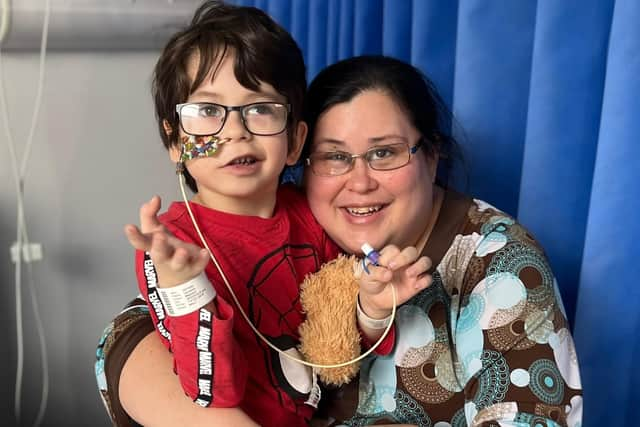

Leo, who lives in Peterborough with his parents Corey and Tim, and younger brother Nathan, was diagnosed with a low-grade glioma in the summer of 2023.
Gliomas are brain tumours that start in glial cells, which are the ‘supporting’ cells or ‘glue’ of the nervous system and therefore help support brain function.
At first, Leo’s symptoms were subtle, but he was complaining of headaches and becoming sick more often. It was while he was undergoing tests for developmental delay that the tumour was discovered, during an MRI scan.
Due to the location of the tumour very centrally in the brain, it cannot be safely removed using surgery, and is something that Leo will be expected to live with long-term, so this trial forms part of Leo’s first line of treatment.
The trial is testing whether a new drug is an effective treatment for a specific group of brain tumour patients - those with newly diagnosed paediatric low-grade gliomas, including those which cannot be completely safely removed, and which contain a specific molecular change called an activating ‘RAF’ alteration, which acts as an ‘on’ switch.
The new drug, which is taken as a liquid or capsule medication weekly, will be compared with standard chemotherapy given via the bloodstream, to see which is better.
The aim is now to show it can be effective earlier in these patients’ treatment, to try and stabilise the tumours and cause some shrinkage, and lessen the long-term side effects of multiple treatments, such as surgeries, standard chemotherapy, and radiotherapy.
The investigational drug has been developed by scientists at a US Biotechnology company, and the study is being delivered globally.
The study team at CUH are being supported by the National Institute for Health and Care Research (NIHR), which supports the delivery of research in the UK.
Leo’s mum, Corey, describes him as an “eclectic” boy who loves arts, crafts, and playing games.
She said: “Being on this trial isn’t just going to help Leo, it’s going to help the next kid and their family, because they’ll be better prepared, and they’ll know a bit more about treatments.
"No parent ever wants to be in this situation, so if we can help anybody else, we’re going to do that, because it’s the right thing to do.
“Taking part in research is a legacy because the more these doctors know, they’ll be able to do so much more for these kids in the future.
"If you look at what we couldn’t do in the past, and we can do now, it’s all because of trials like this. The more people that are part of research and progressing knowledge, the further you can get, and you can do so many more things.”
Dr Charlie Burns, Leo’s Consultant Paediatric Oncologist at CUH added: “We would like to thank Leo and his family for taking part in this research, which we expect to benefit him and future patients. It is how we have been able to improve outcomes for those affected by childhood cancer.
“The advantage for patients of being on this trial is that if they are assigned to the standard chemotherapy and it is shown not to work, then they can automatically ‘cross over’ to receive the investigational drug.”
Professor Matthew Murray, Honorary Consultant Paediatric Oncologist at CUH and Principal Investigator in Cambridge for the trial, added: “This trial is a really exciting development as the investigational drug showed promising results for patients who had relapsed or refractory low-grade gliomas. Now, the trial will test whether it is shows benefit for newly diagnosed patients.”
The trial comes as CUH forges ahead with its plans to build Cambridge Children’s Hospital in partnership with Cambridgeshire and Peterborough NHS Foundation Trust (CPFT) and the University of Cambridge. This specialist children’s hospital for the East of England, will be the first hospital truly designed to bring mental and physical health care together, with world-leading research.
The planned hospital will house a state-of-the-art Cambridge Children's Research Institute (CCRI), accelerating ground-breaking innovations and the benefits of research like this to detect disease early, or prevent it altogether, and personalise treatments that are less invasive and ‘kinder’ for children.
Dr Helen Macdonald, Network Director for the NIHR East of England Regional Research Delivery Network, said:
“We are forever grateful to Leo and his family, and everyone in the East of England who participates in research. Because of them, we are able to make life-changing discoveries through clinical trials.”
If you would like to find out more about research and how you can take part, visit www.bepartofresearch.uk.