
Dozens of people sign up to give just a pint of blood – with that pint going on to potentially save lives.
But more people are needed to donate, as highlighted by the horrific stabbings on a train from Peterborough at the start of November.
On that night, 40 pints of blood was needed to help numerous people who had suffered serious injuries in the incident.
The Peterborough Telegraph went to The Fleet community centre in Stanground to speak to some of the people who had given up just half an hour of their time to make a life changing – and potentially life saving – difference to complete strangers.
“You won't get an award - its just good people doing good things - what more do you need - you've saved someone's life"
David Jackson was making his 112th blood donation – and said it was vital people went out and made the small sacrifice.
He said: “I stated because my sister started - she was a couple of years older than me, and I thought I can't let my sister beat me, and from then I kept going. She had to give up as she kept fainting.
"I've never needed a blood transfusion - there are people out there that go through medical conditions, cancer treatment and people in accidents or who have been attacked.
"It costs me 10 minutes of my time - a small price to pay to give someone the chance of life.
“You won't get an award - its just good people doing good things - what more do you need - you've saved someone's life."
“Particularly for those with RO blood, I would urge you to give blood, it is greatly needed in the country"
One of the big appeals the NHS Blood and Transplant Service is running is for people of black heritage to come forward and give blood.
Some patients with Sickle Cell Disease – which is more common in people with black heritage – need up to 10 pints of blood during a treatment.
People with RO type blood – which again is more common in people of black heritage – are needed to donate blood.
Lloyd Grant was one of the people at The Fleet who had donated who has RO blood – and he urged others to come forward and donate. He said: I give blood on a regular basis, approximately every three months.
"My blood, I am told, is reasonably special - it is RO blood, which helps people with sickle cell - black people, predominantly, so that is the reason I do it. I used to give blood when I was in the army, and I have just kept doing it.
“I did continue when I joined the Red Cross - I was a First Aid instructor there and realised how important it was.
"Particularly for those with RO blood, I would urge you to give blood, it is greatly needed in the country. The blood service tell you where it has gone, which hospital it has gone to, and even to which person, which is really interesting. If you like helping people this is one way you can do it - any type of blood, but particularly if it is rarer blood."
Val Outhwaite, blood session sister said: “We need all blood. O Positive is the most common, but there will be more patients who need it.
"At the moment, we are particularly low of O Negative and B Negative, and then there is a subtype, the RO subtype of blood, which is usually our black heritage donors. We use that for things like sickle cell patients who need regular ongoing transfusions - they have blood exchanges. One sickle patient can receive 10 units in one treatment, and those treatments can be as frequent as every six weeks, so those treatments can use a lot of blood stock.”
"I have been fortunate in my life and it is time to give something back"
Martin Szpak was making his 76th donation. He said: “I think it is important - we are short of blood. I happen to be a bit rare for blood - I am AB Rhesus. I think it is just a great thing to do.
"I started in 1980 - it just became one of these things that I would just donate blood if I have the time, and a lot of the time I couldn't do it, which is a sad excuse really - now I think I should have booked the time off and gone and given blood.
"When you consider the amount of people there are, we could be at the stage where we are not short of blood, but we always are, so we always need it, probably especially with Christmas.
"The incident at Huntingdon I think we had to donate 40 units of blood in a couple of days - that is how quick it goes.
"I would say just give it a go and see what it is like. I have been fortunate in my life and it is time to give something back."
"I lost my grandma this year - to think that by doing this, I could help someone else's grandma fills me with so much gratitude"
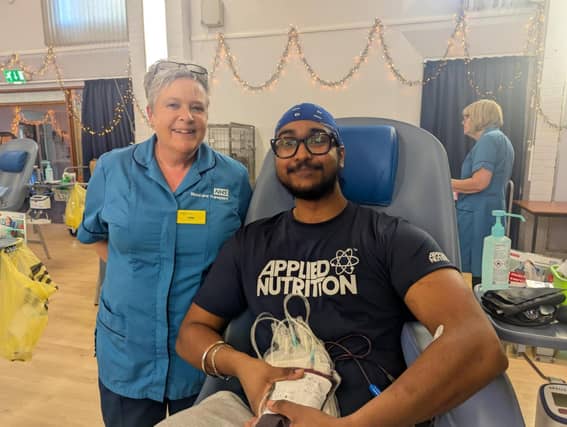
Will Singh is a relative newcomer, having ‘only’ donated for around five years.
He said: “My dad inspired me to give blood. I believe it is a small bit of my day to save lives.
"People need to flip their perspective. It is 20 minutes of your day - if you are happy, and healthy and you have time - you have lovely ladies here taking your blood - and it will save lives.
"I lost my grandma this year - to think that by doing this, I could help someone else's grandma fills me with so much gratitude."
"It is vital that wherever people are, even if they are on holiday over the Christmas period, if they could still make a donation that would be good”
Ms Outhwaite said almost anyone could donate – and urged people to do so.
She said: “Our job is to collect as much blood as we can, but in a safe way to make sure it is safe for the donor who is donating the blood, and also safe for the recipient of the blood.
"We travel all over the country. We are the Huntingdon team, so we are predominantly in the Peterborough area, and we go to village halls, community centres, set up the session, and then our donors will come, book in prior to the session. Gentlemen can donate every three months, ladies every four months.
"Regular donors tend to book their next session as soon as they've given their last donation.
"The donors turn up, we set up before they arrive. Today I have 170 donors booked in, I have 10 donor carers, so hopefully we will collect 170 units of blood - possibly not that much because sometimes we have to defer people - it might be their haemoglobin isn't high enough, or they are on medication that precludes them from donating.
"Each unit of blood - we collect 470ml of blood - and we make various products. So we make packed cells, which is what people refer to as 'the unit of blood' - but that's the red cells that when you have a blood transfusion, that's what people refer to.
"We also make plasma, and pool people of the same blood group together and put their platelets together to make one therapeutic dose of platelets.
"I believe NHS Blood and Transplant supplied 40 units on the very evening of the incident (train stabbing). That would probably have been O Negative blood in the first instance, because when we don't know the patient's blood type, we can give O Negative blood - it is what we call the 'universal donor' as it can be given to anybody in the first instance.
"Obviously when those patients were at hospital they would have been 'tissue typed' and their blood group found, and they would have been matched to the correct blood group for them, but in that first instance O Negative is the vital life saving blood that ambulance, helicopters would carry.
The incident was local and the hospital was local - we had a good response from local donors in the weeks that followed.
"Blood can be transported around the country so if one area is short of a blood group, we can transport it.
"But it is vital that wherever people are, even if they are on holiday over the Christmas period, if they could still make a donation that would be good - as we do struggle over the Christmas period.
"Go online, and type 'Blood' in the search bar, and register to become a donor. You will put your postcode in, and it will bring all the local sessions up. There are several blood centres in London in the evening for those who work in London. The best thing is to book a space before coming."
For more information, visit https://www.blood.co.uk/