
Benedict Blythe inquest: Cross contamination and delays in administering adrenaline at Peterborough school among probable causes of 5-year-old's death
The inquest into the death of Benedict Blythe has returned a conclusion that his death came as a result of accidental exposure to an allergen (cow’s milk protein) causing fatal anaphylaxis.
The jury assessing the death of the five-year-old from Stamford delivered its findings on Wednesday (July 9) after eight days of evidence and deliberations at Peterborough Town Hall.
The findings of the jury were that ‘due process’ was not followed at Barnack Primary School- where Benedict was at the time of going into anaphylactic shock and later into cardiac arrest- in relation to Benedict being given his usual oat milk at snack time.
The inquest found that the most probable way in which Benedict ingested the cow’s milk came from his own drinking receptacle; which was stored at the school.
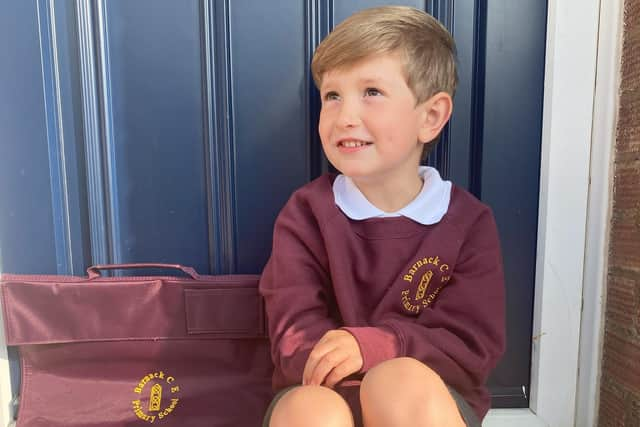

It was noted that ‘it is extremely unlikely that he would have knowingly ingest a known allergen.’
Among the factors that the jury found to have ‘probably caused’ Benedict’s death were:
- Delayed administering of his Adrenaline Auto Injector (EpiPen/adrenaline pen)
- Recent illness and recent exercise, which can increase severe allergic reactions
- His ‘uncontrolled asthma’
- Opportunities for cross-contamination or a mix-up of milk due to control measure at the time
Benedict had a history of anaphylaxis ‘over and above that of a common childhood experience’ and allergies to a number of food stuffs including eggs, nuts, sesame, chickpea and kiwi but most severely to the proteins found in cow’s milk.
Benedict passed away at 12:57pm on December 1, 2021 at Peterborough City Hospital.
Due to Benedict’s allergies his parents and the school collaborated to implement a personal allergy plan, a personalised lunchtime menu and a specific seat for Benedict while he ate.
His oat milk was stored in the staff fridge, away from the ordinary milk given to most of the class, but alongside lactose-free milk for another child in Benedict’s class.
The agreed process was for the milk to be brought to the classroom and poured in Benedict’s receptacle and later returned to the dishwasher but on December 1, this was not followed and the milk was instead poured in the staffroom and taken to the classroom.
After being taken outside to eat his McVitie's ginger biscuit- which lab tests have proven had no milk contamination- Benedict went back inside and picked up his drinking receptacle; shortly after this he vomited. After being cleaned up and changed, he was asked questions about he felt and he asked for his inhaler. He was not given this as he had been sick.
He was then given a book to read before being vomiting again and being taken outside. While outside, he held a brief conversation before becoming ‘grey’ and ‘floppy’ and losing consciousness. He was carried into the classroom and treated with an adrenaline auto injector (EpiPen) twice to no effect, 999 was called at 10:38am. The adrenaline had no effect as Benedict had already entered into cardiac arrest. CPR given by school staff, Benedict’s father Peter and paramedics could not save Benedict. He was transported to PCH but was later pronounced dead at just before 1pm.
In October 2021, Benedict had suffered an allergic reaction when the school served pizza. Benedict was served an allergen-free pizza but is still believed to have suffered a reaction due to air-borne cheese from the other pizzas.
The inquest found that this incident was a ‘missed opportunity’ to review and learn lessons.
The inquest also found that Benedict’s treatment by multiple people made it more difficult to promptly detect anaphylaxis and that his allergy plan was not shared and distributed to all teaching staff that came into contact with him.
It was further added that the fact he was taken out of the classroom- further away from his medication bag and access to first aid- as well as the distracting of him from his symptoms were probable causes of his death.